Showing posts with label News. Show all posts

Friday, May 14, 2010

7 things you shouldn't do on Facebook


Using a Weak Password
Avoid simple names or words you can find in a dictionary, even with numbers tacked on the end. Instead, mix upper- and lower-case letters, numbers, and symbols. A password should have at least eight characters. One good technique is to insert numbers or symbols in the middle of a word, such as this variant on the word "houses": hO27usEs!

Leaving Your Full Birth Date in Your Profile
It's an ideal target for identity thieves, who could use it to obtain more information about you and potentially gain access to your bank or credit card account. If you've already entered a birth date, go to your profile page and click on the Info tab, then on Edit Information. Under the Basic Information section, choose to show only the month and day or no birthday at all.

Overlooking Useful Privacy Controls
For almost everything in your Facebook profile, you can limit access to only your friends, friends of friends, or yourself. Restrict access to photos, birth date, religious views, and family information, among other things. You can give only certain people or groups access to items such as photos, or block particular people from seeing them. Consider leaving out contact info, such as phone number and address, since you probably don't want anyone to have access to that information anyway.

Posting Your Child's Name in a Caption
Don't use a child's name in photo tags or captions. If someone else does, delete it by clicking on Remove Tag. If your child isn't on Facebook and someone includes his or her name in a caption, ask that person to remove the name.

Mentioning That You'll Be Away From Home
That's like putting a "no one's home" sign on your door. Wait until you get home to tell everyone how awesome your vacation was and be vague about the date of any trip.

Letting Search Engines Find You
To help prevent strangers from accessing your page, go to the Search section of Facebook's privacy controls and select Only Friends for Facebook search results. Be sure the box for public search results isn't checked.

Permitting Youngsters to Use Facebook Unsupervised
Facebook limits its members to ages 13 and over, but children younger than that do use it. If you have a young child or teenager on Facebook, the best way to provide oversight is to become one of their online friends. Use your e-mail address as the contact for their account so that you receive their notifications and monitor their activities. "What they think is nothing can actually be pretty serious," says Charles Pavelites, a supervisory special agent at the Internet Crime Complaint Center. For example, a child who posts the comment "Mom will be home soon, I need to do the dishes" every day at the same time is revealing too much about the parents' regular comings and goings.

Copyrighted 2009, Consumers Union of U.S., Inc. All Rights Reserved.

Thursday, December 04, 2008

Dreamweaver CS4: A Powerful Tool for an Imperfect World

With the just-released Dreamweaver CS4, Adobe has conceded that web design has moved on. No longer are designers content to limit themselves to what can be built with WYSIWYG tools; instead, Dreamweaver CS4 shifts focus to providing powerful tools for code-savvy front-end designers like you and me! With the WebKit rendering engine at its core, Dreamweaver CS4 embraces best practice in every aspect of client-side design. If only it went as far on the server side.

Up to and including Dreamweaver CS3, the program was clearly conceived to protect web designers from all the scary code that goes into building a site. It let you generate HTML markup using toolbar buttons and property inspectors instead of tags and attributes. It let you style that markup using wizards and panels instead of CSS rules and properties. The Code View was there if you needed it, but the program did its best to make sure you didn’t.

In recent years, this had become a losing battle as more and more designers needed to take control of their code. It didn’t just matter what the finished product looked like; designers had started to care about what the code looked like too. Dreamweaver’s helpful attempts to hide code behind simple tools became a hindrance more than a help.

Clearly, Adobe has been paying attention. Although the WYSIWYG Design View is still there, as are the panels and wizards, Dreamweaver CS4 adds support for a whole new way of working—one that is largely code-oriented.


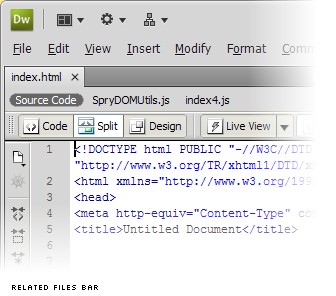
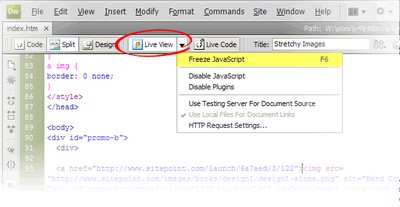
Open an HTML (or PHP, ColdFusion, JSP, ASP, ASP.NET) file in Dreamweaver CS4, and the new Related Files bar instantly displays every other code file in your site that is used to display that page in a browser (or assemble it on the server). Switch on the Live Preview, and instead of the dumb WYSIWYG view of your page, you’ll see the fully-rendered page with all server-side and JavaScript-powered features intact.


Powered by the open source WebKit engine at the heart of browsers like Safari and Google Chrome, the Live Preview is not merely a preview, but a code navigation tool: double-click any element on the page, and the code panel will jump to the HTML code responsible for generating it. If that code is contained in another file, that file is automatically selected in the Related Files bar so that you can edit it without leaving the main file (or its Live Preview) behind!


It gets better: Alt-click any element in the Live Preview, and up pops the Code Navigator with a breakdown of the CSS rules that contribute to the element’s appearance! Click any of these to jump straight to the relevant line of code, where you can make adjustments and watch the Live Preview update instantly.

Read on for my thoughts on why Dreamweaver CS4 may or may not be for you…

Sunday, December 30, 2007

Best of 2007: Most Popular Music Artists

Britney Spears

More than any other single artist, Britney Spears was the driving force behind the return of teen pop in the late '90s. The blockbuster success of the Spice Girls and Backstreet Boys certainly paved the way for her own commercial breakthrough, but Spears didn't just become a star -- she was a bona fide pop phenomenon. Not only did she sell millions of records, she was a media fixture regardless of what she was (or wasn't) doing; among female singers of the era (many of whom followed in her footsteps), her celebrity star power was rivaled only by Jennifer Lopez. From the outset, Spears' sex appeal was an important part of her image; the video for her debut single, "...Baby One More Time," outfitted her in full Catholic-school regalia, and sent her well on the way to becoming an international sex symbol.
read more...

Alicia Keys

Her official website says she possesses an "old soul," and the hard facts seem to back up the implied claim of wisdom and experience that transcend Alicia Keys' youth. Barely in her twenties, Keys was responsible for an extremely hot debut, Songs in A Minor. The release, which she wrote and produced for Clive Davis' J Records, blends diverse influences, including R&B, hip-hop, classical, and jazz. The day the album went on the market, it sold more than 50,000 copies. Label executives confidently predicted similarly favorable numbers for the first week's tally.
read more...

Rihanna

Rihanna established herself big-time in summer 2005 with her debut smash hit, "Pon de Replay," and continued to demonstrate her smash hit potential in subsequent years (e.g., "S.O.S.," 2006; "Umbrella," 2007). By the time of her third album, Good Girl Gone Bad (2007), she was a full-fledged international pop star with a regular presence atop the charts, from Germany to Japan. Born Robyn Rihanna Fenty on February 20, 1988, in Saint Michael, Barbados, she always exhibited a special quality, winning beauty and talent contests as a schoolchild. But because she lived on the fairly remote island of Barbados in the West Indies, she never foresaw the sort of stardom that would later befall her.
read more...

Beyoncé

Born in Houston in the fall of 1981, Beyoncé Giselle Knowles started performing at age seven. From dance classes to singing in the church choir, Beyoncé was a natural. She and cousin Kelly Rowland met Latavia Roberson during this time, and the trio formed a group with Letoya Luckett. Mathew Knowles, Beyoncé's father and Rowland's legal guardian, signed on to be the girls' manager. This situation would ultimately lead to the formation of one of the most popular female R&B groups of all time -- Destiny's Child.
read more...

50 Cent

In many ways the ideal East Coast hardcore rapper, 50 Cent endured substantial obstacles throughout his young yet remarkably dramatic life before becoming in early 2003 the most discussed figure in rap, if not pop music in general. Following an unsuccessful late-'90s run at mainstream success (foiled by an attempt on his life in 2000) and a successful run on the New York mixtape circuit (driven by his early-2000s bout with Ja Rule), Eminem signed 50 to a seven-figure contract in 2002 and helmed his quick rise toward crossover success in 2003. The product of a broken home in the rough Jamaica neighborhood of Queens and, in turn, the storied hood's hustling streets themselves, 50 lived everything most...
read more...

Saturday, August 25, 2007

Problem of Nokia Battery - नोकियाको ब्याट्रिमा खराबी


गत साता मोबाइल सेट निमाता कम्पनी नोकियाको एकखाले ब्याट्रिमा खराबी भएको कुराले संसारभर तहल्का मच्चियो। नोकिया कम्पनीले नै आधिकारिक रुपमा उक्त जानकारी दिएर सचेत रहन आफ्ना ग्राहकलाई आग्रह गरेको थियो। जापानको मात्सुसिता ब्याट्रि इन्डस्ट्रियल कम्पनी लिमिटेडबाट उत्पादित नोकिया ब्रन्डका बी-अल्-५ सी नामक ब्याट्रिमा यस प्रकारको खराबी देखिएको छ। सन २००५ डिसेम्बरदेखि २००६ नोभेम्बरसम्म उत्पादित उक्त ब्रन्डका ब्याट्रिमा प्रविधिक त्रुटि देखिएको कुरा पनि कम्पनीले जनायो। उक्त ब्रन्डका ब्याट्रि चार्ज गर्दा सर्किटहरु बढी तात्ने र त्यसले प्रत्यक्ष असर पुग्ने कुरा बताइयो। नोकियाले उक्त ब्रण्न्डका ३० करोड ब्याट्त्रि उत्पादन गरेको थियो। त्यसमध्ये मात्सुसिता कम्पनीले मात्र ४ करोड ६ लाख ब्याट्रि उत्पादन गरेको थियो। ग्रहकले उक्त अवधिमा उत्पादन भएका ब्याट्रि लाई नोकियाकै वेबसाइटमा जांच गर्न सक्ने व्यवस्था मिलाईको छ। नोकियाको आधिकारिक वेबसाइट www.nokia.com मा गएर ब्याट्रि रिप्लेस्मेन्टमा क्लिक गरी ब्याट्रिमा उल्लेखित २६ अंक टाइप गदा ब्याट्रि खराब हो वा होइन पत्त लगाउन सकिन्छ। खराब ब्याट्रिको सट्टा अर्का ब्याट्रि उपलब्ध गराउने व्यवस्था पनि नोकियाले गरेको छ। ब्याट्रिको कमजोरीका कारण् अहिलेसम्म संसारभर लगभग १ सय घटना घटेका छन्, तर यसबाट कुनै शारीरिक क्षेति भने भएको छैन। नेपालमा नोकियाको अाधिकारिक विक्रेता नियोट्रिक नेपालमार्फत ग्रहकले ब्याटत्रि साट्न सक्ने व्यवस्था मिलाइेको छ। बीएल-५ सीमा लिथियम ब्याट्रि राखिएको छ। लिथियम प्रयोग गरिएको ब्याट्रि विगत केही वर्शदेखि नै विवादमा परेको छ। सोनीले आफ्नो ल्यापटपमा लिथियम प्रयोग गरिएका करिब १ करोड ब्याट्रि बजारवाट फिर्ता लिएको थियो। तोसिवा, डेल तथा लेनोभाले पनि त्यस्तै कदम उठाउनुपरेको थियो। टोयोटा कम्पनीले आफ्नो हाइब्रिड कारको ब्याट्रिमा पनि यस्तै खराबीको सम्भावनाका कारण् यसको लन्चिङमा ढिलाइ गरिरहेको छ।

Thursday, August 16, 2007

Class War: MySpace vs. Facebook

A flurry of recent articles have observed that young people are leaving MySpace for Facebook in droves, setting off speculation that MySpace is becoming the latest victim of fickle teens following the hot new thing.

Not so, says University of California, Berkeley, researcher Danah Boyd. Not all teens are leaving MySpace, she wrote in a recent essay--instead, they're splitting up along class lines.

Boyd confirms what teens in any high school across the country already know: Affluent kids from educated, well-to-do families have been fleeing MySpace for Facebook since it opened registration to the general public in September, while working-class kids still flock to MySpace.

That could have big implications for advertisers targeting the coveted teenaged population online, three-quarters of whom have a profile on a social network. Both sites have been powerhouses for advertisers because of their huge, wide-reaching audiences, says Robin Neifield, chief executive of interactive marketing agency NetPlus Marketing. That strategy could change if the sites become more like the niche social networks popping up across the Web for groups of like-minded people from similar backgrounds.

Boyd's essay came amid speculation about the future of the social network giants. Despite the fact that MySpace still gets more than twice as many unique visitors as Facebook, it's littered with postings announcing that users, often teens, are switching to its rival.
The number of Facebook visitors ages 12 to 17 jumped 149% over the past year, while MySpace lost 27% of teens, according to ComScore Media Metrix. Rupert Murdoch, whose News Corp.owns MySpace, even lamented in an interview that he was losing readers to Facebook. News Corp. is rumored to be considering swapping MySpace for a 25% stake in Yahoo!.

Estimated ad revenue for 2007 calendar year for Facebook is $125 million, $525 million for MySpace, according to research firm eMarketer. Together, the two account for 72% of all online advertising on social networks.

There's a reason why the "goody-two-shoes, jocks, athletes or other 'good' kids" are going to Facebook, says Boyd, who studies social networks and youth culture and made her observations based on formal interviews with 90 teens, informal interviews with hundreds more, and the perusal of tens of thousands of teens' online profiles.

Facebook launched in 2004 as a site for Harvard students. Gradually, it opened up to other college students, then to high school kids if a college student invited them. "Facebook is what the college kids did. Not surprisingly, college-bound high schoolers desperately wanted in," Boyd writes.

MySpace, meanwhile, is the "cool working-class thing" for high school students getting a job after graduation rather than heading to the Ivy League, Boyd writes. Constant local news stories on predators targeting kids on MySpace further alienated the "good kids," she says. Both companies declined to comment on Boyd's essay.

"As an advertiser, in my opinion, Facebook users are more qualified to convert and more apt to buy a shirt, so I would go there before MySpace," says Josh Mohrer, director of retail for BustedTees, an online purveyor of hipster clothes and sometime Facebook advertiser.

Facebook can lure advertisers with its affluence, says Bill Tancer, general manager of global research at Hitwise, an online marketing analysis firm. His data backs up Boyd's conclusions that Facebook users are richer than those on MySpace. Still, MySpace attracts so many more viewers that "there's no way marketers are going to leave," he says.

NetPlus chief Neifield says she's not paying too much attention to Boyd's observations. Advertisers should look beyond demographics when placing ads and instead analyze online behavior like who visited other sites with similar content, who downloaded what or who clicked on which ads, she says. "It's not very often these days that we buy based on demographics alone."

By Claire Cain Miller, Forbes.com

Friday, August 03, 2007

SEO as a Dirty Business

In real life, presidential election campaigns are run behind closed doors and their actors often play dirty tricks on each other; for "All's fair in love and war." The final purpose of the game is political supremacy. Power. In SEM... the top of Google's SERP.

From Graywolf's "How to Be a Dirty Digger" to Greenberg's "The Saboteurs of Search" we learn that online marketing and politics play on similar grounds.That the search engines can be manipulated is no secret, but most SEOs try a positive approach and define their strategies as ethical or "white-hat."

In Aaron Wall's dictionary, there is no such thing as ethical SEO because, no matter how you look at it, once you employ a technique (any) to manipulate the search engines, you "SPAM." The only question is what kind of spam is acceptable from a Google perspective?

Part of the answer comes from Google's Webmaster Guidelines (quality guidelines - specific guidelines), more comes from Bruce Clay's SEO code of ethics, and if that's not enough you could always rely on an answer from authority SEO professionals.

Now back to SEO as a dirty business.

Strangely enough in real life it is a lot easier to harm than to heal. Somehow supremacy and power are achieved faster through war than peaceful negotiations. No surprise here: negotiating peacefully takes time to find a compromise which, in many situations, is not what the parts involved hoped to achieve.

SEM is quite similar. For every winner, there's a loser, and many companies that rely on Google for traffic employ questionable SEO tactics to achieve good rankings for their most competitive keyword phrases.

But this is nothing compared to those that employ "political tricks" to harm their competitors. Forbes lists in "The Saboteurs of Search" two techniques (out of seven): Google bowling and Google insulation.

Google bowling is pure evil and it deals with how to frame a competitor's site as a spamming site to convince Google to drop its rankings. This type of negative SEO deals with links -- and many links at once. These links are generated automatically, over a short period of time, using special software. They'll mostly come from bad neighbors and they'll all have the same anchor text, to make the spam picture complete. Google is just a machine, so there's no real way for this machine to know who is behind the link spam. The "guilty" site might lose its position in the SERP or even get banned. Some sites never recover after a Google ban, others see their rankings vanishing and their pages landing into the supplemental results and they never learn why.

If something like this has happened to your site, all you can really do is to find out who hates you so much. Google bowling is not the only negative SEO technique that might hurt a competitor site.

Tattling, as correctly identified by Forbes, is something that even Google's Matt Cutts encourages, by asking people to report sites that buy links. I really wonder how Google verifies such complaints.

Basically anyone can assume that a contextual link in one of my blog entries is a paid link (what if I monetize my site with V7 contextual?).

There are many other questionable SEO strategies to demolish competition. I happen to consider them a waste of time and energy. The Forbes article quoted above contains a pretty interesting statement: "Matt Cutts, a senior software engineer for Google, says that piling links onto a competitor's site to reduce its search rank isn't impossible, but it's extremely difficult."

If negative SEO is difficult, we are prone to believe that it seldom happens. I think that, in some niches, it happens quite often. But these are simple theories. As long as I do not have the data to back them up, I prefer to keep my analysis to a minimum of delivering information.

There are simpler ways to harm competition. Scrapper sites harm writers by copying their content. And it is not that difficult to understand where the "harm" lies.

For example, when a scrapper copies the content of your site, your rankings are harmed, especially if the scrapper site happens to have more authority than yours. There is not much you can do to protect your rankings and your copyright. But if you decide to report the guilty site to the search engine (file a compliant) the search engine will remove the site from its index for 10 days, to give you (the copyright holder) the time to sue for infringement.

Many bloggers wake up one day to find their articles duplicated on obscure sites, MFA sites and so on. They are often frustrated and they ask in forums the classic: what can I do if someone copies my content. Well, now you have a possible answer: you don't need to go to court to punish a site for copyright infringement. It is enough to file a complaint at Google and you've got the guilty site out of the Google SERPs for at least 10 days.

Careful though, a fraudulent copyright complaint can get you in trouble, and not just with the search engines. So don't just go around filing complaints. The Google ban theoretically lasts for just 10 days, but the trust rank of the accused site will lower. Another similar complaint and the site's integrity will be seriously questioned. Just remember: what goes around, comes around.

By, Mihaela Lica
Entireweb.com

Wednesday, April 11, 2007

iPod's 100 million milestone

iPod's 100 million milestone Apple's iconic iPod MP3 player has clocked up 100 million sales, the company has announced.

The milestone makes the iPod the fastest selling music player in history.

Apple has brought out more than ten new models since the first one was sold in November 2001.

The technology giant's chief executive, Steve Jobs, said: "At this historic milestone, we want to thank music lovers everywhere for making iPod such an incredible success.

"IPod has helped millions of people around the world rekindle their passion for music, and we're thrilled to be a part of that."

Since its launch, Apple has brought out five new versions of the standard iPod, two generations of iPod minis, two iPod nanos and two iPod shuffles.

The music player has spawned an "ecosystem" of some 4,000 related accessories made by a host of different firms.

Apple's next move will be into the film download market.

Its latest new gadget - code named the iTV - wirelessly transmits iTunes' music, film, TV and video content from users' computers to their flat screen televisions.

Saturday, January 13, 2007

इन्टरनेट धूम

सूचना प्रविधिको विकासक्रमसँगै मोफसलमा पनि प्रयोगकर्ता बढेका छन् । विशेषगरी विद्यार्थी, व्यापारी, सञ्चारकर्मी तथा 'टिनएजर' हरू यसतर्फआकषिर्त भेटिएका छन् । जसमध्ये अधिकांश च्याटिङमा सीमित छन् ।

वीरगन्ज सहरमा दैनिक ५ हजारभन्दा बढी ग्राहकले साइबर प्रयोग गर्ने गरेका छन् । यहाँस्थित एक दर्जन साइबरमा बारा र पर्साका युवायुवती तथा विद्यार्थीको भीड लाग्ने गरेको छ । यहाँ नेपाल टेलिकमका अलावा वर्ल्डलिंक, मर्कन्टाइल तथा एटीसीलगायतले इन्टरनेट सेवा उपलब्ध गराएको सेन्टर प्वाइन्ट साइबरका विकासजंग राणाले बताए ।

प्रयोगकर्तामध्ये अधिकांशले आफ्ना साथीहरूसँग च्याटिङ गरेर समय कटाउने गरेको साइबरवाला बताउँछन् । 'एमबीबीएस अध्ययनको तयारीमा आएको', १२ किलोमिटर पर जीतपुर बजारबाट वीरगन्ज आएका असरफ अलीले भने- 'किताबमा नभेटिएका कुरा यहाँ खोज्छु, अनि विदेशका कलेजबारे पनि खोज्दैछु ।

परीक्षाको रिजल्ट समयमै हेर्न पाइने तथा दरखास्त फारम र कोर्सबुकमा नेभेटिएका अध्ययन सामग्रीसमेत नेटबाटै डाउनलोड गर्न मिल्ने हुँदा यसतर्फआफू आकषिर्त भएको भनाइ उनको छ ।

पत्रकारका लागि पनि उत्तिकै आकर्षस्थल बनेको छ साइबर । पत्रकार महासंघका सभापति विनोद प्याकुरेल भन्छन्- 'फोटो पत्रकारका लागि त इन्टरनेट वरदान नै सावित भएको छ । बारा र पर्सामा कार्यरत दुइ दर्जनभन्दा बढी फोटो पत्रकारले साइबरको राम्रो उपयोग गरिरहेको उनले बताए ।

झापाको दमक बजारस्थित साइबरमा पनि घन्टौं बिताउनेको संख्या अत्यधिक रहेको पाइएको छ । त्यहाँस्थित कान्तिपुर संवाददाताका अनुसार डेढ दर्जन साइबर क्याफेमा युवायुवतीको भीड नै लाग्ने गरेको छ । 'लाहुरे' को बाक्लो बस्ती रहेको यस बजारमा विदेशिएका आफन्तसँग भिडियो च्याट गरेर मख्ख पर्ने बूढाबूढीको संख्या पनि अधिक छ ।

लहानमा युवायुवतीले भने अश्लील तस्बिरको खोजीमा बढी समय बिताउने गरेको त्यहा“स्थित संवाददाताले जनाएका छन् । पाँचवटा साइबर क्याफे रहेको यस बजारमा दैनिक ५ सयभन्दा बढीले इन्टरनेट प्रयोग गरेको अनुमान साइबर- वालाहरूको छ । यहाँका केही व्यापारी भने आफ्नो कारोबारसमेत नेटमार्फ गर्न थालेका छन् । लहानका पुर्बमेयर मुन्नी साह आफू अफसेट प्रेससम्बन्धी केही नयाँ प्रविधि आएका छन् कि भनेर खोज्न बसेको बताउँछन् । लहान प्राविधिक शिक्षालयमा अध्ययनरत बाग्लुङका प्रमोद गिरी भने आफूले प्रविधिका नयाँ पाटा नेटमार्फ जान्न साइबर बसेको बताए ।

चितवनस्थित संवाददाताका अनुसार यहाँ व्यापारिक प्रयोजनका लागिसमेत नेटको सहारा लिन थालेको पाइएको छ । युवा पुस्ताले भने समुद्रपार अध्ययन उपायबारे घन्टौं खोजतलास गर्ने गरेका छन् । र् पर्यटकीय सहर पोखरामा पनि इन्टरनेट लोकप्रिय हुँदैछ । यहाँका साइबर क्याफेमा स्थानीय युवायुवतीदेखि पर्यटकसमेतको घुइँचो लाग्ने गरेको छ । यसका अलावा यहाँका साइबरले वेबसाइटमार्फ पोखराको चिनारी र यस भेगका मोडलको परिचय बनाउने काममा जुटेका छन् । 'लभ्ली पोखरा डट कम' यहाँको प्रिय वेबसाइट हो ।

Source: ekantipur.com